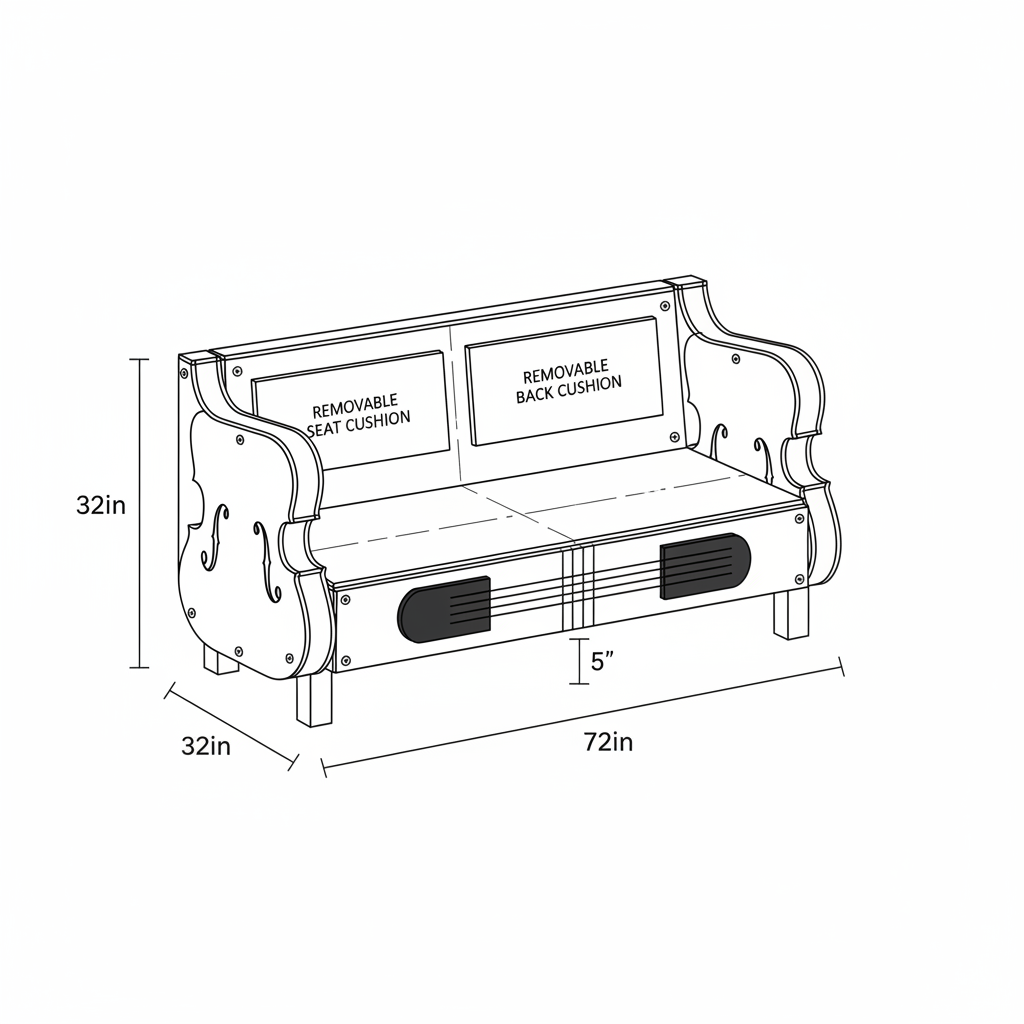
A simple two-person cello-themed wooden couch that can realistically be built by two high-school students with basic woodworking tools. The couch should be approximately 72 inches wide, 32 inches deep, and 32 inches tall. Use two matching 3/4-inch plywood side panels shaped like a simplified cello body. The cello curves should be large and easy to cut with a jigsaw, not complicated or highly detailed. Each side panel should also act as an armrest. Build a strong rectangular internal frame from standard dimensional lumber to safely support the seat and people sitting on it. Use mostly straight cuts for the internal frame, seat platform, backrest, and front. Include one removable seat cushion and one removable back cushion. Add simple cello-inspired decorative features such as an f-hole in each plywood side panel and a dark fingerboard-style piece with four decorative strings across the lower front. Keep the cello decorations non-structural. Use screws, wood glue, plywood, and commonly available lumber. Avoid complicated woodworking joints, bent wood, CNC machines, or advanced tools. The finished couch should look clearly inspired by a cello while being inexpensive, sturdy, comfortable, and achievable as a high-school woodworking project. Please provide exact dimensions, a materials list, cut list, tools, and step-by-step assembly instructions.

A simple two-person cello-themed wooden couch that can realistically be built by two high-school students with basic woodworking tools. The couch should be approximately 72 inches wide, 32 inches deep, and 32 inches tall. Use two matching 3/4-inch plywood side panels shaped like a simplified cello body. The cello curves should be large and easy to cut with a jigsaw, not complicated or highly detailed. Each side panel should also act as an armrest. Build a strong rectangular internal frame from standard dimensional lumber to safely support the seat and people sitting on it. Use mostly straight cuts for the internal frame, seat platform, backrest, and front. Include one removable seat cushion and one removable back cushion. Add simple cello-inspired decorative features such as an f-hole in each plywood side panel and a dark fingerboard-style piece with four decorative strings across the lower front. Keep the cello decorations non-structural. Use screws, wood glue, plywood, and commonly available lumber. Avoid complicated woodworking joints, bent wood, CNC machines, or advanced tools. The finished couch should look clearly inspired by a cello while being inexpensive, sturdy, comfortable, and achievable as a high-school woodworking project. Please provide exact dimensions, a materials list, cut list, tools, and step-by-step assembly instructions.

A student-friendly, highly robust two-person wooden couch designed to mimic the elegant silhouette of a cello. Built using standard 3/4-inch plywood and common 2x4 framing lumber, it features a heavy-duty internal frame to completely prevent center-sag over its 72-inch span. This plan utilizes simple, straight cuts and heavy-duty pocket-screw joinery, ensuring that high school woodworkers can construct a structural masterpiece with basic shop tools.

beginner wood furniture

Dimensions: {"unit":"in","depth":32,"width":72,"height":32,"autoEstimate":false}

Materials

Tools Required