Published: November 4, 2026
From multi-nozzle 3D printing updates and AWS welding inspection career paths to publishing shop manuals for passive revenue and cutting clean timber beam notches, here is your daily shop briefing for Wednesday, November 4, 2026.
Welcome back to the workbench for Wednesday, November 4, 2026. Pull up a stool, pour a fresh cup of coffee, and let's get into today’s shop briefing. We’re covering multi-nozzle 3D printing upgrades, AWS welding inspector career pathways, monetizing shop manuals for high-margin income, and structural floating shelf joinery that won't pull out of the drywall.
🔧 Cool New Tools
Bambu Lab H3C & Multi-Nozzle Mixing Timelines
Bambu Lab pulled back the curtain on its upcoming H3C platform and PLA Palette material line, pushing desktop additive manufacturing closer to industrial tool-changing performance. The key tech takeaway is nozzle mixing—the capability to run different nozzle orifice diameters within the same print job.
Instead of laying down an entire model with a single 0.4mm nozzle, the system switches dynamically:
- 0.8mm Nozzle: Used for fast internal infill (e.g., 15% Gyroid) at high volumetric flow rates (up to 32 mm³/s).
- 0.2mm or 0.4mm Nozzle: Used exclusively for outer perimeters and fine geometric detail.
This slashes overall print time on large shop jigs and production enclosures by up to 40% without compromising surface finish. Bambu confirmed that nozzle mixing firmware will roll out to the H2D platform starting late November 2026, with retrofits for legacy units scheduled across February and March 2027.
Alongside the H3C preview, the new PLA Palette semi-translucent filament line hit tester hands. It yields controlled light diffusion—ideal for custom backlit control panels, status indicator lenses, and shop lamp housings.
DIY PET-G Bottle Filament Pultrusion
For shop owners trying to minimize plastic waste, bottle-to-filament recycling pultrusion rigs are maturing rapidly. By stripping discarded PET/PETG beverage bottles into uniform 8mm ribbons and pulling them through a heated 200°C brass nozzle, you can produce consistent 1.75mm filament on a benchtop machine.- Material Specs: Recycled PETG offers tensile strength around 50 MPa and a heat deflection temperature of 70°C.
- Shop Application: While not recommended for precision tight-tolerance gear trains, recycled bottle filament is ideal for custom tool organizers, material bins, and rough structural shop brackets.
🏗️ Trade Career Spotlight
AWS Welding Journal: Certified Welding Inspector (CWI) Pathways
The October and November 2026 issues of the AWS Welding Journal and Inspection Trends highlight a widening gap in quality assurance: as senior inspectors retire across structural steel, aerospace, and pipeline sectors, certified inspection roles are seeing historic demand.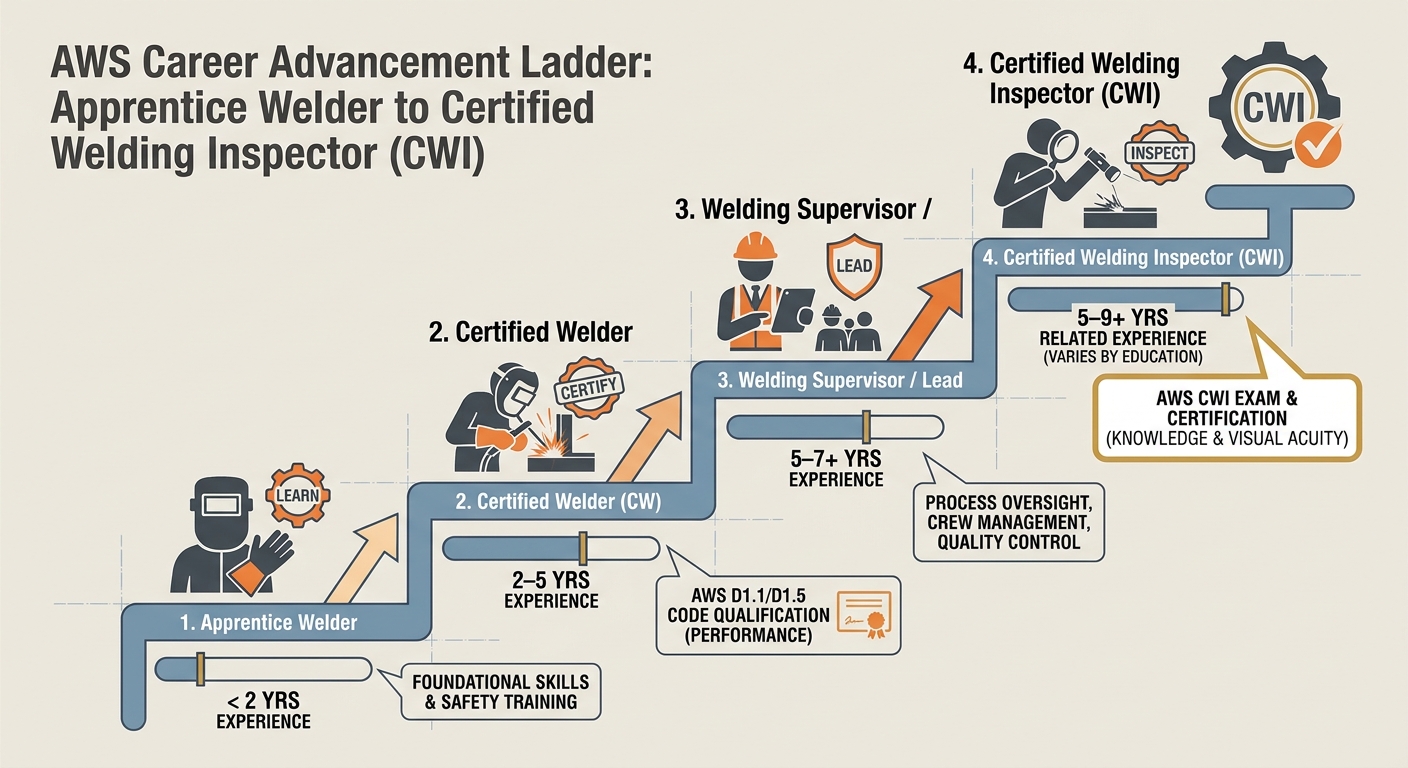
Moving from the hood to the inspection clipboard isn't just a physical break from grinding fumes—it’s a direct pay jump:
- Field Journeyman Welder: $28 – $38 / hour average base.
- AWS Certified Welding Inspector (CWI): $45 – $68 / hour base, with specialized field NDT leads commanding $120k+ annually.
What it takes to cross over:
- Practical Experience: You need a minimum of 5 years of verified fabrication/welding experience under AWS D1.1 or ASME standards (3 years if you hold an associate degree in welding technology).
- The AWS CWI Exam: A three-part exam covering Fundamentals (Part A), Practical Inspection with visual gauges and code replica specimens (Part B), and Open-Book Codebook Application (Part C, usually AWS D1.1 or API 1104).
- Key Skill Set: Focus on mastering Visual Testing (VT), Ultrasonic Testing (UT), and Magnetic Particle Testing (MT). Understanding non-destructive testing procedures makes you indispensable to general contractors and structural fabricators who need fast field buy-offs.
💰 Maker Mogul Corner
Turn Shop Manuals into High-Margin Digital Products
Trading shop hours directly for build dollars caps your monthly revenue at your physical capacity. If you've spent years dialing in precise cut lists, custom jig templates, or specialized assembly techniques, you're sitting on valuable digital assets.Instead of only building custom items one off, document your process and self-publish digital guides.
+-------------------------------------------------------------+
|               TRADITIONAL CUSTOM WORK VS DIGITAL            |
+-------------------------------------------------------------+
| Custom Timber Gate Build  : 16 Hours Labor | $1,200 Revenue |
| Digital Jig & Plan Manual :  8 Hours Setup | $25/sale (x100)|
|                           = $2,500 Passive Profit           |
+-------------------------------------------------------------+
How to structure sellable shop documentation:
- Target Niche Shop Needs: Write guides for specific local building challenges—like Building Code Compliant Timber-Framed Deck Beams or Custom Heavy-Duty Sliding Barn Door Hardware.
- Include Complete Bill of Materials (BOM): Standardize fasteners, timber species, and exact tooling required. Include DXF files for laser-cut brackets alongside standard PDFs.
- Distribution Setup: Use low-overhead platforms (KDP for print manuals, Gumroad or shop websites for direct CAD/PDF downloads). Keep overhead below 10%.
- Pricing Strategy: Price complete plan packages between $15 and $45. Selling 40 digital plan sets a month creates $600–$1,800 in high-margin passive cash flow that reinvests directly into new shop iron or upgraded CNC machinery.
🛠️ DIY Mastery
Clean Beam Joinery & Structural Floating Shelves
A common mistake in custom interior work is relying on flimsy drywall anchors or cheap commercial bracket rods for heavy solid-wood floating shelves. When hanging a 2-inch thick white oak mantel or heavy timber beam, the bracket system must be engineered for real leverage and dead weight.
Mounting Heavy Timber Shelves Right:
[ Solid Wall Stud ]
            |
            |-- (5/16" x 3.5" Structural Lag Bolt)
            |
    +-------+--------------------------+
    | Steel Backing Plate (1/4" Thick) |
    +-------+--------------------------+
            |
            |====== (3/4" Solid Steel Rod, Welded)
            |       \
| \---> Inserted into 13/16" Bored Hole in Timber- Stud Anchor Selection: Never rely on drywall hollow anchors for shelves deeper than 6 inches. Locate center points on wall studs (16" or 24" on-center) using a deep-scanning stud finder.
- Steel Backplate Bracket: Fabricate or buy a welded blind shelf bracket featuring a 1/4" thick steel mounting plate with solid 3/4" cold-rolled steel support rods.
- Fasteners: Fasten the plate to framing studs using 5/16" x 3.5" heavy-duty structural lag screws (e.g., GRK Fasteners). Pre-drill pilot holes to avoid splitting aged 2x4 framing.
- Boring Timber: Bore receiving holes into the back of your wood stock using an 13/16" Forstner bit mounted in a drill guide jig to guarantee perfectly perpendicular alignment.
- False Timber Beams: When crafting hollow ceiling box beams to mimic solid timbers, rip your material edges at a precise 45° miter on the table saw. Glue using polyurethane adhesive and pull joints tight with blue painter's tape turned tourniquet-style every 6 inches. Sand corners gently to burnish the wood fibers, creating a seamless solid-wood illusion.
Keep Building
Whether you're caliRead the full article on TigerDen.